Pumpkin Bread

Easy moist pumpkin bread is the loaf that makes October mornings feel organised. It is a quick bread — no yeast, no kneading, two bowls and a whisk — baked once and eaten all week: toasted in a pan with butter, packed cold for lunch, or taken from the freezer a slice at a time. A good pumpkin loaf is tender rather than cakey, warmly spiced, and moist enough to leave a faint sheen on your fingers. That comes down to three decisions: oil instead of butter, the right ratio of pumpkin to flour, and bicarbonate of soda doing more than just lifting the batter. Measurements are in grams, with a note on homemade purée, since tinned is hard to find in much of Europe. Save this one for the first cold weekend.
Why pumpkin bread is made for meal prep
Most bakes peak within hours of leaving the oven; pumpkin bread runs the other way. Its crumb is so wet and well sweetened that it stales slowly and improves overnight, so making it ahead is the point rather than a compromise. One loaf gives ten generous slices that freeze individually between sheets of baking paper — take out exactly one on a busy morning.
Ingredients
- 220 g plain flour (1 3/4 cups)
- 1 tsp bicarbonate of soda (baking soda)
- 1/2 tsp fine salt
- 2 tsp ground cinnamon
- 1 tsp ground ginger
- 1/2 tsp freshly grated nutmeg
- 1/4 tsp ground cloves
- 340 g pumpkin purée, tinned or homemade (1 1/2 cups)
- 120 ml neutral oil, such as sunflower or rapeseed (1/2 cup)
- 100 g soft light brown sugar (1/2 cup, packed)
- 100 g caster sugar (1/2 cup)
- 2 large eggs, at room temperature
- 60 ml milk (1/4 cup)
- 1 tsp vanilla extract
- Optional top: 2 tbsp pumpkin seeds · 1 tbsp demerara sugar
How to make it
- Heat the oven and line the tin. 175C (160C fan). Grease a 900 g / 2 lb loaf tin (about 23 × 13 cm) and line it with a baking-paper sling.
- Whisk the dry ingredients for 30 seconds. A clump of bicarbonate bakes into a bitter, soapy pocket.
- Whisk the wet ingredients separately — pumpkin, oil, both sugars, eggs, milk and vanilla — until smooth.
- Fold the dry into the wet and stop early. About fifteen strokes with a spatula. Small lumps are fine; they disappear in the oven.
- Fill and top. Level the batter and scatter over the pumpkin seeds and demerara, if using.
- Bake 60-70 minutes, until a skewer in the centre comes out clean or with a few moist crumbs — about 95C inside. If the top darkens by 45 minutes, lay foil loosely over it.
- Cool 10 minutes in the tin, then lift it onto a rack by the paper before steam turns the sides damp.
- Wait at least an hour before slicing. A hot loaf is still setting inside and cuts gummy.

Why this loaf stays moist: oil, pumpkin and a little alkalinity
Fat matters more here than in almost any other bake. Butter is roughly 80% fat and 16% water, and its fat is solid at room temperature, so as a butter loaf cools the fat crystallises again and the crumb firms up and reads as drier. Oil stays liquid at kitchen temperature: a cool slice feels as soft as a warm one. Oil also coats the flour proteins and limits gluten formation — the reason baking fat is called "shortening" — for a tender, close crumb.
Pumpkin purée is around 90% water, but water held in place: pectin and soluble fibre from the squash's cell walls bind it into a gel instead of letting it steam away. The molasses in brown sugar adds invert sugars that hold moisture, and sugar also competes with starch for water, which slows staling. Too little pumpkin gives spice cake; too much and the loaf cannot set, leaving a wet band along the bottom.
Pumpkin and molasses are both mildly acidic. Bicarbonate of soda reacts with them to release carbon dioxide, and any soda left over makes the batter slightly alkaline. A higher pH speeds up the Maillard reaction, so the crumb bakes to a deep russet and the crust tastes deeply toasted. Too much soda tastes soapy — hence one level teaspoon.
The crack along the top is not a fault: the crust sets before the centre finishes rising, and the middle bursts through. And the loaf really is better the next day, as moisture migrates outwards from the wet centre, softening the crust so slices cut cleanly. Overmixing is a real fault — it bakes into tunnels under a tough, peaked crown.

Storing, freezing and reheating
Room temperature: keep the cooled loaf wrapped or in an airtight container for up to 3 days. A crumb this moist can turn mouldy sooner in a warm kitchen, so move it to the fridge after day two.
Fridge: up to a week, well wrapped. The crumb firms because starch recrystallises fastest at fridge temperature, but warming a slice reverses it.
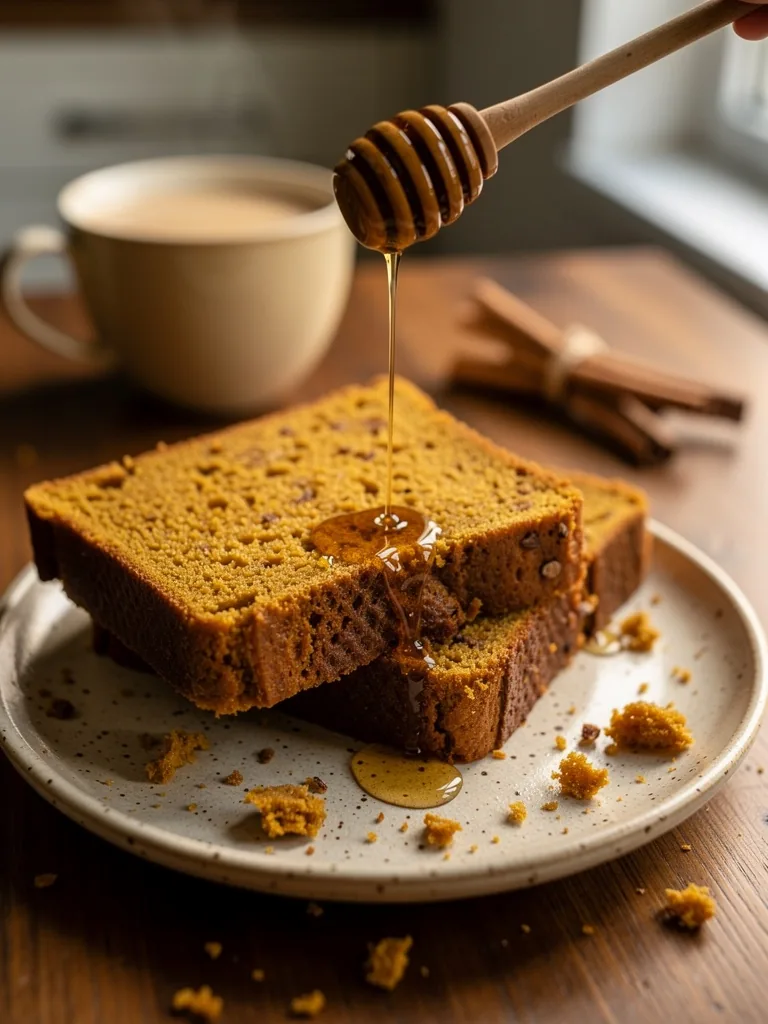
Freezer: slice it cold, interleave with baking paper and freeze in a bag, air pressed out, for up to 3 months. Toast straight from frozen on a low setting, or fry in a little butter for 2-3 minutes a side and finish with a thread of honey. Thaw a whole loaf overnight in its wrapping, so condensation forms on the wrap rather than the bread.
Make-ahead and batch tips
- Purée ahead: homemade purée freezes for 3 months in flat 340 g bags; opened tinned purée keeps 5-7 days in a covered container in the fridge.
- Dry jar: weigh the dry ingredients into a labelled jar for a ten-minute baking day.
- Double batch: bake two tins side by side on the middle shelf, swap them after 40 minutes, and allow 5-10 minutes extra.
- Smaller shapes: the batter makes 12 muffins (22-25 minutes) or 4 mini loaves (35-40 minutes).
Variations to keep it interesting
- Dark chocolate: fold in 120 g, chopped.
- Walnut and maple: 75 g toasted walnuts; brush the warm top with maple syrup.
- Cream cheese ribbon: 150 g cream cheese, 30 g sugar and 1 egg yolk, layered through the middle; bake 10 minutes longer and refrigerate.
- Brown butter: replace half the oil with 60 g browned, cooled butter for a toasted flavour.
- Wholegrain: swap a third of the flour for wholemeal spelt and add 1-2 tbsp extra milk.
Troubleshooting
- It sank in the middle. Underbaked, or the purée was too wet. Bake to a clean skewer and drain homemade purée.
- Gummy streak along the bottom. Too much or too-wet purée, or a loaf sliced while hot.
- Dark crust, raw centre. A hot oven or a dark metal or glass tin. Drop 10C and tent with foil earlier.
- Dry and crumbly. Overbaked, or flour scooped with a cup. Weigh it.
- Soapy aftertaste. Heaped or poorly whisked soda.
A note for European kitchens
Tinned purée is rare in Europe outside the UK, but homemade works perfectly. Halve and deseed a Hokkaido (red kuri) or butternut squash, roast it cut side down at 200C (180C fan) for 35-45 minutes until tender, then scoop and blend. Hokkaido is fairly dry, close to tinned. Butternut holds more water: drain the purée in a paper-lined sieve for 30-60 minutes until it holds its shape on a spoon, then weigh it. Skip watery carving pumpkins.
Plain flour is Type 405 in Germany and type 45 or 55 in France; bicarbonate of soda is sold as Natron. Continental "brown sugar" is often dry, coarse cane sugar, so use light muscovado, or caster sugar plus 1 tbsp golden syrup. A 25 cm Kastenform matches a 900 g tin; a 30 cm one gives a lower loaf that bakes about 10 minutes faster. And 3 tsp of Lebkuchengewürz can stand in for all four spices.
Made it? Save the recipe to your breakfast board so it is ready for the next cold weekend.
Save to PinterestFAQ
- Can I use butter instead of oil in pumpkin bread?
- Yes — 125 g melted butter. It tastes richer, but the loaf is firmer and seems drier once cool, since butter's fat sets at room temperature. Half and half is a good compromise.
- Can I use fresh pumpkin instead of tinned purée?
- Yes. Roast Hokkaido or butternut until soft, blend, and drain until thick enough to hold its shape on a spoon, then weigh.
- How do I freeze pumpkin bread?
- Slice it cool, separate the slices with baking paper and freeze in an airtight bag for up to 3 months. Toast straight from frozen.
- Why did my pumpkin bread sink in the middle?
- Usually underbaking. Very wet purée, too much soda or opening the oven in the first 40 minutes can also cause it. Bake until a skewer comes out clean.
Pin Crafts Food recipes are researched and developed with the help of AI tools and carefully reviewed and edited by Mara Linden for accuracy, clarity and real-kitchen practicality.