Coq au Vin
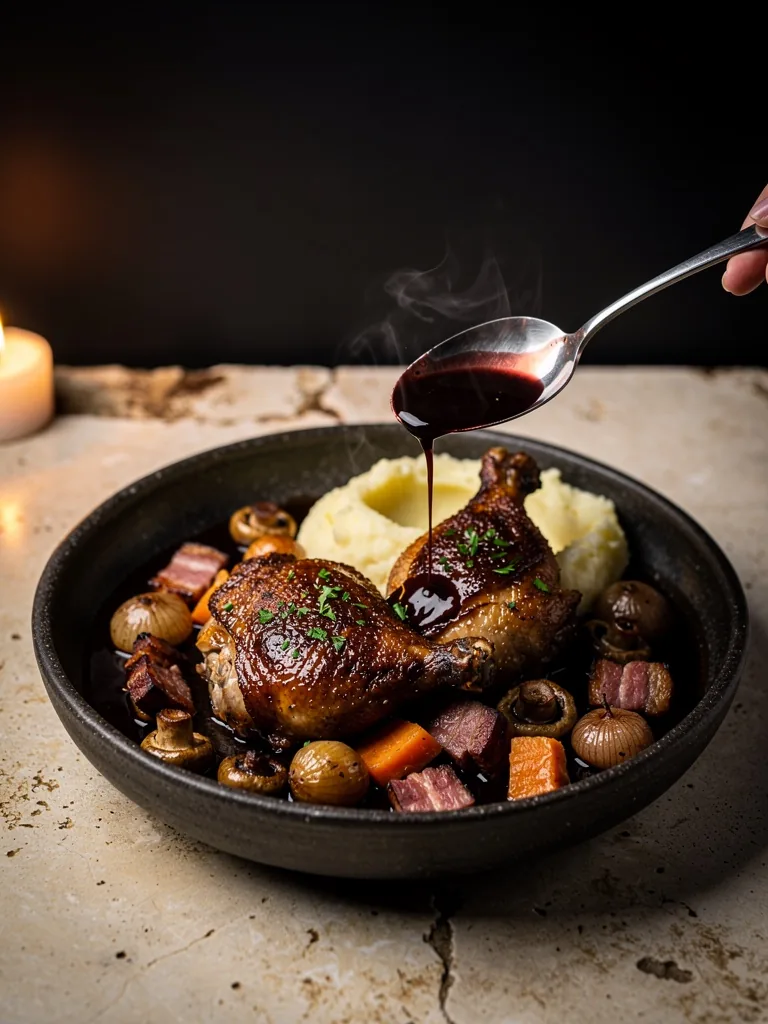
Easy coq au vin is far less complicated than its reputation: chicken thighs browned hard in smoky bacon fat, then braised slowly in red wine until the meat slips off the bone and the sauce turns dark and glossy. Easy does not mean quick: nothing here is difficult once you understand the two things it depends on, and most of the time belongs to the oven. Coq means rooster, and the dish was traditionally made with a mature bird whose tough meat needed hours; bone-in thighs give the same rich, forgiving result in about one. Around them goes the classic Burgundian garnish of lardons, mushrooms and glazed small onions, the same one that finishes boeuf bourguignon. Save this one for the first cold weekend.
The one thing that makes it work: brown hard, then braise gently
Coq au vin is a two-temperature dish. First, fierce and short: dry skin against hot fat until it turns deep mahogany. Then a long, quiet stretch in a low oven where the liquid barely trembles. The browning builds flavour; the braise builds texture.
Browning needs dry skin. The Maillard reactions behind a savoury crust only run properly from around 140C upwards, and while there is water on the surface, it stays near 100C. Wet skin, or a crowded pan leaking juices, steams pale.
The braise needs thighs, not breast. Leg meat carries more collagen-rich connective tissue and more fat. Held moist above roughly 70C for long enough, collagen breaks down into gelatin, which makes thighs silky and gives the sauce body. Breast has almost no collagen, so a long braise just tightens its fibres until it is dry and stringy. Even thighs want gentle heat: a rolling boil squeezes juice from the fibres before the collagen has converted.

Ingredients
- 1.6 kg (3 1/2 lb) bone-in, skin-on chicken thighs and drumsticks (about 8 pieces)
- 1 1/2 tsp fine salt and black pepper
- 150 g (5 oz, 1 cup) smoked lardons or pancetta
- 1 tbsp neutral oil
- 1 onion (150 g / 1 cup), finely chopped
- 2 carrots (200 g / 1 1/2 cups), cut into thick rounds
- 3 garlic cloves, crushed
- 2 tbsp tomato paste (tomato purée in the UK)
- 750 ml (3 cups, one bottle) dry, medium-bodied red wine, ideally red Burgundy (Pinot Noir)
- 250 ml (1 cup) chicken stock
- Bouquet garni: 4 thyme sprigs, 2 bay leaves, a few parsley stalks, tied
- 250 g (9 oz, 3 cups) small chestnut or button mushrooms
- 200 g (7 oz, 1 1/2 cups) pearl onions or small shallots
- 40 g (3 tbsp) butter and a pinch of sugar, for the garnish
- Beurre manié: 25 g (2 tbsp) soft butter and 25 g (3 tbsp) plain flour
- Chopped flat-leaf parsley, to serve
Step by step, with the why at each stage
- Dry and salt the chicken. Pat it thoroughly dry and season, ideally a day ahead, uncovered on a rack in the fridge. The cold, open air dries the skin further, so it browns faster.
- Render the lardons from cold. Lardons and oil into a cold 26-28 cm Dutch oven, medium heat, 8-10 minutes until golden; lift out. A gentle start melts out the fat you will brown in.
- Sear in batches, then leave it alone. Medium-high, skin-side down, with space between pieces: 6-8 minutes until deep mahogany, 2-3 on the other side. Skin that sticks is not ready; browned skin releases by itself.
- Vegetables, then tomato paste. Pour off all but 2 tablespoons of fat. Soften the onion and carrots for 5 minutes, the garlic for 1, then fry the tomato paste for 1-2 minutes until brick red. This caramelises its sugars and removes its raw, tinny edge.
- Boil the wine. Pour it in, scrape up every browned bit (the fond is concentrated flavour) and boil hard, uncovered, for 5 minutes until reduced by a quarter. This drives off part of the alcohol and the raw-wine smell a covered pot would trap.
- Assemble. Add the stock and bouquet garni, return the lardons and nestle in the chicken skin-side up, with the liquid about three-quarters of the way up. Bring to a simmer.
- Low oven, lid ajar. 160C (140C fan) for 60-75 minutes, until the meat pulls easily from the bone. The oven heats from all sides, so nothing scorches; the gap under the lid lets steam escape and keeps the liquid at a lazy simmer, not a boil.
- Cook the garnish on the side. Blanch the pearl onions for 1 minute, peel, then glaze in half the butter with the sugar and 3 tablespoons of water for 10-12 minutes until golden. Brown the mushrooms in the remaining butter over high heat, in one layer, for 6-8 minutes. Mushrooms are about 90 percent water: in the pot they would release it and stew grey, while in a hot, uncrowded pan it evaporates and they brown.
- Thicken and finish. Lift out the chicken, discard the herbs and skim off the fat. Simmer the sauce (reduce it first if thin), whisk in the kneaded butter and flour bit by bit and simmer for 2-3 minutes until it coats a spoon. Return everything, warm through for 5 minutes, season and add parsley. Serve with mash or a baguette.

What the wine does in the pot, and which bottle to open
Boiling the wine first drives off part of the alcohol and its sharp, solvent-like edge — but not all of it. Widely cited USDA figures put retention at roughly a quarter after an hour of simmering and about a tenth after two.
Reduction concentrates acids and tannins rather than removing them, so a heavy, oaky, tannic red can turn harsh. Red Burgundy (Pinot Noir) is traditional for good reason: medium body, soft tannins, bright fruit. Beaujolais, Côtes du Rhône or a German Spätburgunder work the same way. Use a wine you would happily drink, since faults concentrate too, but it needn't be a special bottle; long cooking flattens the delicate aromas first.
The rest of the pot balances the wine. Browned tomato paste and glazed onions add sweetness, and gelatin from the thighs rounds out the sauce — winemakers use gelatin to bind harsh tannins. Then the beurre manié: kneading flour into butter coats each starch granule in fat, so it disperses without lumps. In the hot sauce the granules absorb water and swell (starch gelatinisation), which takes a couple of minutes at a simmer to thicken fully and cook out the raw-flour taste.

Troubleshooting: what goes wrong and how to fix it
- Pale skin that stuck. Wet chicken, a crowded pot, or turned too soon. Dry it well, brown in batches, wait for it to release.
- Sharp or boozy sauce. The wine was not boiled long enough. Simmer uncovered a few minutes more; finish with a knob of cold butter.
- Thin sauce. Reduce before thickening, or add another teaspoon each of butter and flour.
- Tough meat. More time, not more heat: another 15-20 minutes.
- Dry, stringy meat. It boiled, or breast went in. Lower the oven, keep the lid ajar, use thighs.
Making it ahead, storing and reheating
Coq au vin genuinely benefits from a night in the fridge: the meat reabsorbs some sauce, the seasoning evens out, and the fat sets on top, where you can lift it off. Cool within two hours and refrigerate, covered, for up to 3 days. Reheat gently, covered, on low heat or in a 160C oven for 25-30 minutes until piping hot. It freezes for 3 months; thaw overnight in the fridge.
For European kitchens: buy smoked Speckwürfel in German-speaking shops, lardons or pancetta in the UK. No fresh pearl onions? Use small shallots, not jarred silverskins, which are pickled. Oven: 160C top and bottom heat or 140C fan, in a 26-28 cm cast-iron Bräter of 5-7 litres. Red Burgundy may be labelled Bourgogne rouge; Spätburgunder is the same grape.
Made it? Save the recipe to your dinner board for a slow Saturday and an even better Sunday.
Save to PinterestFAQ
- Can I use chicken breast for coq au vin?
- Not well — it has almost no collagen and dries out long before thighs turn tender. If you must, brown it and add it for the last 20-25 minutes only.
- What is the best red wine for coq au vin?
- Traditionally red Burgundy (Pinot Noir); any dry, medium-bodied red with soft tannins works.
- Do I need to marinate the chicken in wine overnight?
- No. A marinade penetrates only a few millimetres, and wet chicken browns poorly. Salting the dry pieces the day before does more.
- Does the alcohol cook off completely?
- No — USDA figures suggest about a quarter remains after an hour of simmering, so skip it for guests who avoid alcohol.
Pin Crafts Food recipes are researched and developed with the help of AI tools and carefully reviewed and edited by Mara Linden for accuracy, clarity and real-kitchen practicality.